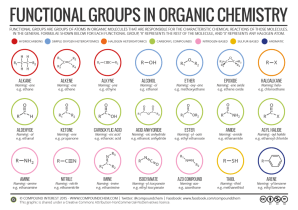
Groups of atoms (also known as moities) or bonds within molecules that are responsible for the characteristic chemical reactions of those molecules are known as functional groups. Functional groups are atoms connected by covalent bonds. It is common to see molecules comprised mainly of a carbon backbone with functional groups attached to the chain. The functional group gives the molecule its properties; functional groups are centers of chemical reactivity.
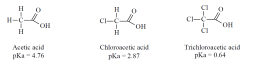
Relative reactivity can be modified by nearby functional groups. For example, a carboxylic acid can become more acidic due to the electronegativity of nearby atoms. For example, acetic acid’s pka is not as low as the pka of trichloroacetic acid due the presence of hydrogens as opposed to chlorine atoms. Inductive effects refer to those electronic effects of an atom or functional group can contribute through single bonds such as saturated (sp3) carbon atoms. Atoms or functional groups that are electronegative relative to hydrogen such as the halogens, oxygen, nitrogen withdraw electron density through the single bond structure of a compound and can assist in the stabilization of negative charge that may form in reactions. One such reaction where -Cl groups can have a stabilizing (enhancing) effect is the ionization of acids.
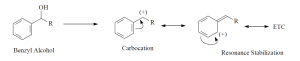
The terms resonance and induction refer to the electronic effects that atoms or functional groups may have within a compound. These effects are dependent on the valence, bonding order and electronegativity of atoms, as well as the molecular geometry. Resonance may be defined as bonding or sharing of electrons between more than two atoms. Typical covalent and ionic bonding involves sharing (covalent) or transferring (ionic) electron pairs between two atoms. An example of resonance is shown below. Note the direction of the arrow (from partial negative to partial positive or from lone pair to positive charge)
 General-Organic-Biochemistry