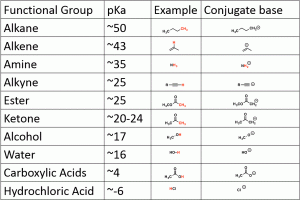
Relative acidities of functional groups predict their reactivity. The acid dissociation constant, Ka, (also known as acidity constant, or acid-ionization constant) is a quantitative measure of the strength of an acid in solution. It is the equilibrium constant for a chemical reaction known as dissociation in the context of acid–base reactions. By examining the Ka or the pKa it is possible to determine the relative acidity of a compound. The larger the value of pKa, the smaller the extent of dissociation at any given pH. Another way of saying this is the smaller the pKa, the stronger the acid or the more likely the compound is to dissociate a hydrogen. Acids with a pKa value of less than about −2 are said to be strong acids; the dissociation of a strong acid is such that the concentration of the undissociated acid is too small to be measured. A selection of functional groups and their respective pKa are shown below.
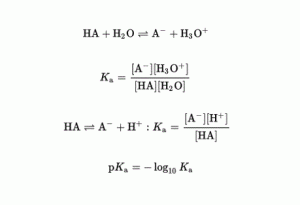
In aqueous solution, the equilibrium of acid dissociation can be represented as shown below where HA represents the acid A- the conjugate base.
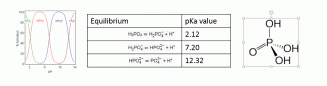
Polyprotic acids are acids that can lose more than one proton. The constant for dissociation of the first proton may be denoted as Ka1 and the constants for dissociation of successive protons as Ka2, Ka3. Phosphoric acid, H3PO4, is an example of a polyprotic acid capable of losing three protons.
 General-Organic-Biochemistry