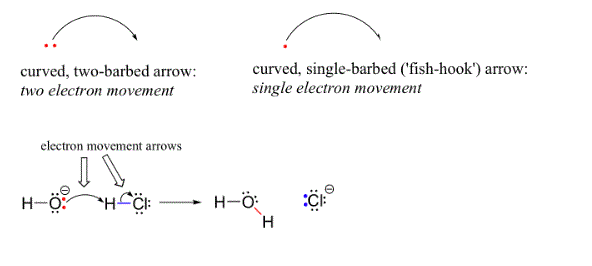
When considering chemical reactivity, the best description is the transfer of an atom or electrons which represents the forming or breaking of a bond. For example, in an acid and base reaction, the acid transfers a proton to a base or another way of saying this is that the lone pair of electrons on the base takes the proton. A key to understanding a reaction mechanism is electronegativity and electron movement. The base is more electronegative and the acid has low electron density by comparison. The hydroxide ion due to the electronegative oxygen atom in the hydroxide ion has high electron density. The hydrogen atom in HCl, on the other hand, has low electron density: it is electron-poor. There is an attraction between electron rich and electron poor. As hydroxide and HCl approach each other, a lone pair of electrons on the electron-rich hydroxide oxygen is attracted by the electron-poor proton of HCl, and electron movement occurs towards the proton. The two electrons in the hydrogen-chlorine bond are repelled by this approaching hydroxide electron density, moving even farther away from the proton and towards the chlorine nucleus. The consequence of the electron movement is that the hydrogen-chlorine bond is broken, as the two electrons from that bond completely break free from the hydrogen and become a lone pair in the chloride anion. Curved arrows represent electron movement when drawing two or more resonance contributors for a single molecule or ion. These same curved arrows are used to show the very real electron movement that occurs in chemical reactions, where bonds are broken and new bonds are formed. The HCl + OH– reaction, for example, is depicted by drawing two curved arrows. The first arrow originates at one of the lone pairs on the hydroxide oxygen and points to the ‘H’ symbol in the hydrogen bromide molecule, illustrating the ‘attack’ of the oxygen lone pair and subsequent formation of the new hydrogen-oxygen bond. The second curved arrow originates at the hydrogen-bromine bond and points to the ‘Br’ symbol, indicating that this bond is breaking – the two electrons are ‘leaving’ and becoming a lone pair on bromide ion. It is very important to emphasize at this point that these curved, two-barbed arrows always represent the movement of two electrons.
HCl + OH– H2O + Cl–
 General-Organic-Biochemistry