When there is an insufficient amount of a given reagent known as the limiting reagent, the reaction will slow and eventually stop. One way to determine the limiting reagent is to determine the amount of the product generated by a given reagent. In order to determine the limiting reagent, first determine the balanced chemical equation for the chemical reaction. Then, convert all information provided into moles (for example using molar mass as a conversion factor). By calculating the mole ratio, it is possible to compare the calculated ratio to the actual ratio. Use the amount of limiting reagent to calculate the amount of product generated. It is also possible to calculate how much of the excess reagent remains after the limiting reagent has been consumed to produce the product. An alternate approach to finding the limiting reagent is to balance the chemical equation for the chemical reaction. Then convert the given information into moles. Use stoichiometry to determine the amount of the product generated. The reactant that produces the lesser amount of product is the limiting reagent. The reactant that produces the greater amount of product is the excess reagent. To find the amount of excess reagent remaining, subtract the mass of excess reagent consumed from the total mass of the excess reagent.
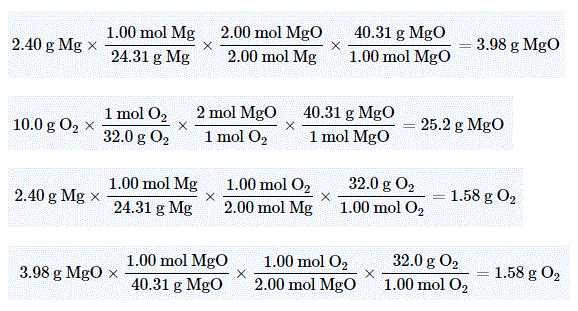
For example: Calculate the mass of magnesium oxide possible if 2.40 g Mg reacts with 10.0 g O2
Balance the equation: 2Mg (s) + O2 [arrow] 2MgO
Convert mass to moles using stoichiometry:
The reactant that produces a smaller amount of product is the limiting reagent: Mg produces less MgO than does O2 (3.98 g MgO vs. 25.2 g MgO), therefore Mg is the limiting reagent in this reaction.
The reactant that produces a larger amount of product is the excess reagent: O2 produces more amount of MgO than Mg (25.2g MgO vs. 3.98 MgO), therefore O2 is the excess reagent in this reaction.
Find the amount of remaining excess reactant by subtracting the mass of the excess reagent consumed from the total mass of excess reagent given: Mass of excess reagent calculated using the limiting reagent:
Or alternatively:
Mass of total excess reagent given – mass of excess reagent consumed in the reaction
10.0g – 1.58g = 8.42g O2 is in excess.
 General-Organic-Biochemistry