Reactions stoichiometry determines the amount of a substance that is produced or consumed by a reaction. The first step in stoichiometry involves balancing the equation. For example, when magnesium burns in oxygen, the balanced equation is:
2Mg (s) + O2 2MgO
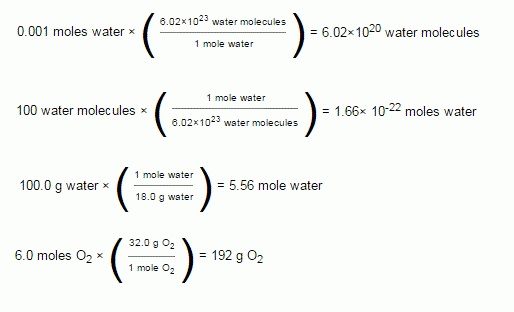
Once the balanced equation is correct, it is possible to calculate the amount (as a solid, liquid or gas) depending on the type of reactant or product in a variety of units. For mass, the most common units are kilograms (kg), grams (g), milligrams (mg). For liquids, the most common units are liters (L) or milliLiters (mL). For gases, the units vary from pascals (Pa) to atmospheres (atms) to millimeters mercury (mmHg) to Torr. To complete the calculations for stoichiometry, it is important to convert the amount in grams or Liters or Pascals into moles. A mole of a substance is defined as: The mass of substance containing the same number of fundamental units as there are atoms in exactly 12.000 g of 12C. The number of grams in a mole is different from substance to substance. A dozen cats have a different weight than a dozen dogs- but in each case, you have a dozen animals. Likewise, a mole of oxygen gas has a different weight than a mole of water- but in each case, you have 6.02×10²³molecules. A mole of any substance is 6.02×10²³ molecules of that substance. Use this as a conversion factor to turn moles into molecules.
Or the opposite, note dimensional analysis allow conversion any unit from any unit.
A mole of any substance is the molecular weight of that substance in grams. For example, H2O has a molecular weight of 18.0 (16.0 for the oxygen and 1.0 for each hydrogen), so the mole-to-gram relationship for water is based on the molecular weight of the molecule:
1 mole water = 18 g water
Or alternately, use this as a conversion factor to turn grams to moles to find out how many grams there are in 6.0 moles of O2
Examples are shown:
 General-Organic-Biochemistry