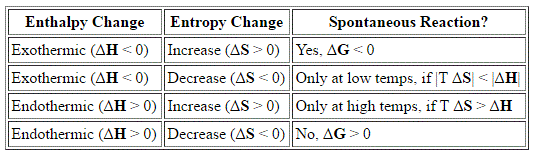
Entropy is a measure of the disorder of a system. The idea of Entropy comes from the second law of thermodynamics, which states that all systems tend to increase in disorder. The significance of entropy is that when a spontaneous change occurs in a system, a positive value for Entropy will be obtained. Spontaneous changes in an isolated chemical system occur with an increase in entropy. Entropy, like temperature, pressure, and enthalpy, is also a state property and is represented in the literature by the symbol “S”. Like enthalpy, usually the change in Entropy is calculated (ΔS). Enthalpy change, Entropy change, and change in free energy (Gibbs Free Energy) are related. A spontaneous reaction is one that occurs without any outside intervention. Processes that are spontaneous in one direction are non-spontaneous in the reverse direction.
Introduction to Equilibrium
Equilibrium is when both reactants and products are present in concentrations which have no further tendency to change with time. Usually, this state results when the forward reaction proceeds at the same rate as the reverse reaction. Depending on conditions, a reaction can proceed in the forward or in the reverse direction. In a closed system, reversible reactions undergo dynamic equilibrium. The reaction continues but the concentrations of the reactants and products does not change. If there is a change in the conditions of the equilibrium, the position of equilibrium can change, favoring the products or the reactants. Another way of saying this is that in changing the conditions of the system, it is possible to change the rate of the forward or reverse reaction. Le Chatelier’s Principle states that if a dynamic equilibrium is disturbed by changing the conditions, the position of equilibrium moves to counter the changes. Another way of saying this is that the system is always seeking equilibrium. In the simplest case, assume the reactants are A and the products are B. By decreasing the concentration of A, the reverse reaction would occur, producing more of the starting materials. Likewise, if the concentration of B increased, the reverse reaction would also occur, producing more of the starting materials. Increasing the temperature of a system in dynamic equilibrium causes the system to favor an endothermic reaction, absorbing the additional heat. Alternatively, decreasing the temperature of a reaction in dynamic equilibrium favors an exothermic reaction, the system produces more heat.
Introduction to Gibb’s Free Energy
The rate of a reaction is the change in concentration of the reactants or the change in concentration of the products per unit time. The definition of chemical equilibrium when the forward reaction rate and the reverse reaction rate are equal. The result of this equilibrium is that the concentrations of the reactants and the products do not change. The rate constant, k, measures how fast a chemical reaction reaches equilibrium assuming the reactants were supplied with enough activation energy to enable the reaction to proceed in the forward direction from reactants to products. The need for energy is due to the fact that the reactants are unreactive under certain conditions. In this case, the reaction must have some sort of energy input before it can proceed; otherwise, the reactants cannot cross the activation energy threshold and convert to products. The reaction is activated by energy supplied to the reactants by different energy sources. The rate of reaction, the rate constant, and the kinetic energy required for activation of reaction indicate how fast the reaction reaches equilibrium.
For all chemical reactions there is a kinetic and thermodynamic component. The quantity related to kinetics is the rate constant k. The rate constant is associated with the activation energy required for the reaction to proceed according to the reactivity of the reactants. The thermodynamic quantity is the energy difference resulting from the free energy (ΔG) given off during a chemical reaction: how stable the products are relative to the reactants. Although kinetics describes the rate of reaction and how fast equilibrium is reached, it provides no information about conditions once the reaction equilibrates. In the same measure, thermodynamics only gives information regarding the equilibrium conditions of products after the reaction takes place, but does not explain the rate of reaction. Chemical reactivity and stability are two related but distinct concepts 1) kinetics describes whether reactants need to be energized to produce products. It does not consider the overall energy on the activation energy what is required. Conversely, thermodynamics is a state function concerned with the energy of both reactant(s) and product(s). Whether a reaction is spontaneous depends on both the initial and final state. Those reactions with a higher free energy or higher potential chemical energy require energy to drive the reaction as they are not capable of liberating energy and thus being spontaneous. The most stable states of a kinetic reaction are those of the reactants, in which an input of energy is required to move the reaction from a state of stability, to that of reacting and converting itself to products. Kinetics is related to reactivity. In contrast, the most stable state of a thermodynamically favorable reaction is the products, because the reaction occurs spontaneously, without the need for energy to be added. Thermodynamics is related to stability.
Introduction to Thermodynamics
The study of the relationship between heat and work within chemical reactions is known as thermodynamics. Chemical thermodynamics helps to determine whether a reaction proceeds spontaneously as well as determining whether a reaction is reversible or irreversible. Chemical energy is the potential energy with a substance that can be used by making or breaking bonds, which can absorb or evolve heat. As heat and work are both forms of energy, they can be transformed into each other. Work and heat can both be described using the same unit of measure. Sometimes the calorie is the unit of measure, and refers to the amount of heat required to raise one (1) gram of water one (1) degree Celsius. Heat energy is measured in kilocalories, or 1000 calories. Typically, the SI units of Joules (J) and kilojoules (kJ) can be converted into calories. One calorie of heat is equivalent to 4.187 J. The term specific heat is also relevant, the heat required to raise one (1) gram of a material one (1) degree Celsius. Specific heat, given by the symbol “C.”
Chemically, when energy is converted to work, energy in the form of heat moves from one place to another, or energy is stored up in the constituent chemicals. Heat is defined as that energy that is transferred as a result of a temperature difference between a system and its surroundings. Mathematically, we can look at the change in energy of a system as being a function of both heat (q) and work (w). If q is positive, we say that the reaction is endothermic, that is, heat flows into the reaction from the outside surroundings. If q is negative, then the reaction is exothermic, that is, heat is given off to the external surroundings.
Enthalpy is a state property, the word enthalpy comes from the Greek “heat inside”. If a chemical system undergoes some kind of change, but has a fixed volume, the heat output is equal to the change in internal energy (q = ΔE). Define the enthalpy change, ΔH, of a system as being equal to its heat output at constant pressure. So in order to calculate the change in enthalpy, calculate the enthalpy of products minus the enthalpy of reactants.
Introduction to Mechanisms
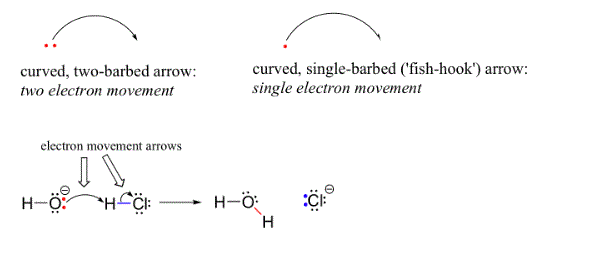
When considering chemical reactivity, the best description is the transfer of an atom or electrons which represents the forming or breaking of a bond. For example, in an acid and base reaction, the acid transfers a proton to a base or another way of saying this is that the lone pair of electrons on the base takes the proton. A key to understanding a reaction mechanism is electronegativity and electron movement. The base is more electronegative and the acid has low electron density by comparison. The hydroxide ion due to the electronegative oxygen atom in the hydroxide ion has high electron density. The hydrogen atom in HCl, on the other hand, has low electron density: it is electron-poor. There is an attraction between electron rich and electron poor. As hydroxide and HCl approach each other, a lone pair of electrons on the electron-rich hydroxide oxygen is attracted by the electron-poor proton of HCl, and electron movement occurs towards the proton. The two electrons in the hydrogen-chlorine bond are repelled by this approaching hydroxide electron density, moving even farther away from the proton and towards the chlorine nucleus. The consequence of the electron movement is that the hydrogen-chlorine bond is broken, as the two electrons from that bond completely break free from the hydrogen and become a lone pair in the chloride anion. Curved arrows represent electron movement when drawing two or more resonance contributors for a single molecule or ion. These same curved arrows are used to show the very real electron movement that occurs in chemical reactions, where bonds are broken and new bonds are formed. The HCl + OH– reaction, for example, is depicted by drawing two curved arrows. The first arrow originates at one of the lone pairs on the hydroxide oxygen and points to the ‘H’ symbol in the hydrogen bromide molecule, illustrating the ‘attack’ of the oxygen lone pair and subsequent formation of the new hydrogen-oxygen bond. The second curved arrow originates at the hydrogen-bromine bond and points to the ‘Br’ symbol, indicating that this bond is breaking – the two electrons are ‘leaving’ and becoming a lone pair on bromide ion. It is very important to emphasize at this point that these curved, two-barbed arrows always represent the movement of two electrons.
HCl + OH– H2O + Cl–
Limiting Reagent
When there is an insufficient amount of a given reagent known as the limiting reagent, the reaction will slow and eventually stop. One way to determine the limiting reagent is to determine the amount of the product generated by a given reagent. In order to determine the limiting reagent, first determine the balanced chemical equation for the chemical reaction. Then, convert all information provided into moles (for example using molar mass as a conversion factor). By calculating the mole ratio, it is possible to compare the calculated ratio to the actual ratio. Use the amount of limiting reagent to calculate the amount of product generated. It is also possible to calculate how much of the excess reagent remains after the limiting reagent has been consumed to produce the product. An alternate approach to finding the limiting reagent is to balance the chemical equation for the chemical reaction. Then convert the given information into moles. Use stoichiometry to determine the amount of the product generated. The reactant that produces the lesser amount of product is the limiting reagent. The reactant that produces the greater amount of product is the excess reagent. To find the amount of excess reagent remaining, subtract the mass of excess reagent consumed from the total mass of the excess reagent.
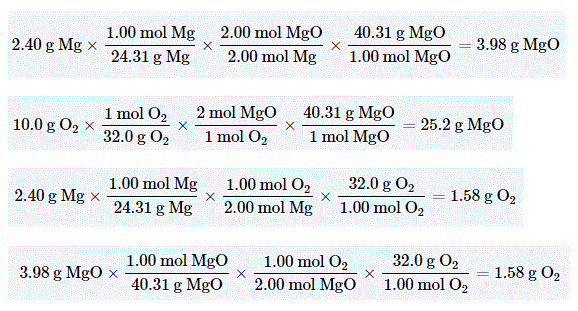
For example: Calculate the mass of magnesium oxide possible if 2.40 g Mg reacts with 10.0 g O2
Balance the equation: 2Mg (s) + O2 [arrow] 2MgO
Convert mass to moles using stoichiometry:
The reactant that produces a smaller amount of product is the limiting reagent: Mg produces less MgO than does O2 (3.98 g MgO vs. 25.2 g MgO), therefore Mg is the limiting reagent in this reaction.
The reactant that produces a larger amount of product is the excess reagent: O2 produces more amount of MgO than Mg (25.2g MgO vs. 3.98 MgO), therefore O2 is the excess reagent in this reaction.
Find the amount of remaining excess reactant by subtracting the mass of the excess reagent consumed from the total mass of excess reagent given: Mass of excess reagent calculated using the limiting reagent:
Or alternatively:
Mass of total excess reagent given – mass of excess reagent consumed in the reaction
10.0g – 1.58g = 8.42g O2 is in excess.
Stoichiometry
Reactions stoichiometry determines the amount of a substance that is produced or consumed by a reaction. The first step in stoichiometry involves balancing the equation. For example, when magnesium burns in oxygen, the balanced equation is:
2Mg (s) + O2 2MgO
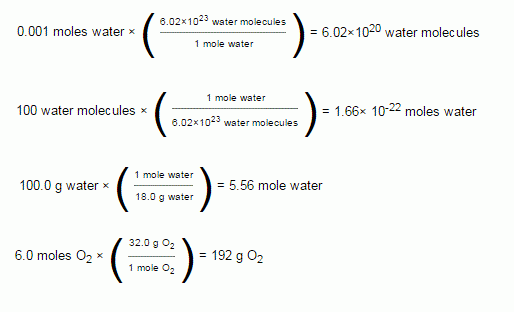
Once the balanced equation is correct, it is possible to calculate the amount (as a solid, liquid or gas) depending on the type of reactant or product in a variety of units. For mass, the most common units are kilograms (kg), grams (g), milligrams (mg). For liquids, the most common units are liters (L) or milliLiters (mL). For gases, the units vary from pascals (Pa) to atmospheres (atms) to millimeters mercury (mmHg) to Torr. To complete the calculations for stoichiometry, it is important to convert the amount in grams or Liters or Pascals into moles. A mole of a substance is defined as: The mass of substance containing the same number of fundamental units as there are atoms in exactly 12.000 g of 12C. The number of grams in a mole is different from substance to substance. A dozen cats have a different weight than a dozen dogs- but in each case, you have a dozen animals. Likewise, a mole of oxygen gas has a different weight than a mole of water- but in each case, you have 6.02×10²³molecules. A mole of any substance is 6.02×10²³ molecules of that substance. Use this as a conversion factor to turn moles into molecules.
Or the opposite, note dimensional analysis allow conversion any unit from any unit.
A mole of any substance is the molecular weight of that substance in grams. For example, H2O has a molecular weight of 18.0 (16.0 for the oxygen and 1.0 for each hydrogen), so the mole-to-gram relationship for water is based on the molecular weight of the molecule:
1 mole water = 18 g water
Or alternately, use this as a conversion factor to turn grams to moles to find out how many grams there are in 6.0 moles of O2
Examples are shown:
Chemical Equations
The process where bonds are broken and/or bonds are formed is a chemical reaction. As the making or breaking of bonds involves the storage or release of energy, a chemical reaction must obey the laws of thermodynamics such as energy cannot be created or destroyed, only transferred. A chemical reaction has the reactants, what atoms or molecules are combined, on the left followed by an arrow to form the products on the right, the atoms and/or molecules that are the outcome of the chemical reaction. A plus sign indicates the combination of two or more reagents or starting materials. As written, the chemical equation must balance: the number of the same type of atoms on the left must equal the number of the same type of atoms on the left.
For example consider the combustion reactions of some simple hydrocarbons:
CH4 + 2O2 [arrow] CO2 + 2H2O
2C2H6 + 7O2 [arrow] 4CO2 + 6H2O
C3H8 + 5O2 [arrow] 3CO2 + 4H2O
2C4H10 + 13O2 [arrow] 8CO2 + 10H2O
When dealing with chemical equations with polyatomic ions, where ions are made of more than one atom, there is a special strategy to balance the chemical equation: treat the whole polyatomic ion as if it is only one atom. Let’s take a look at this chemical equation. For example:
Na3PO4 + MgCl2 [arrow] NaCl + Mg3(PO4)2
The polyatomic ion in this case is PO4. Treat this whole polyatomic ion as one atom. On the reactants side there is one PO4 ion and on the products side, there are two PO4 ions. The first step is to balance the polyatomic ions on both sides. To do that place a coefficient of 2 in front of Na3PO4. The sodium (Na) atoms double and the PO4 is now balanced on both sides.
Colligative Properties and Osmolarity
Colligative Properties change due to the presence of a solute. The magnitude of the change is due to the number of particles in the solution and not their chemical identity. Examples of properties that fall under this category are the vapor pressure, melting and boiling points, and osmotic pressure. Changes of state depend on vapor pressure, so the presence of a solute affects the freezing point and boiling point of a solvent. In a solution only a fraction of the molecules with energy in excess of the intermolecular force are nonvolatile solute molecules. This reduction in the number of solvent molecules with energies above the intermolecular force lowers vapor pressure of the solution than the pure solvent at all temperatures. The presence of solute particles interferes with the crystallization process and thus the normal melting point is lower; this means more energy needs to be removed to favor crystallization or the formation of a solid. For example, the normal boiling point of a liquid occurs at the temperature where the vapor pressure is equal to 1 atmosphere. A nonvolatile solute elevates the boiling point of the solvent. The magnitude of the boiling-point elevation depends on the concentration of the particles of solute. When a solute is dissolved in a solvent, the freezing point of the solution is lower than that of the pure solvent. The equation for freezing-point depression is similar to that for boiling-point elevation.
Osmotic Pressure occurs when a solution and a pure solvent are separated by a semipermeable membrane, which does not allow the solute molecules to pass through only allowing the solvent to cross the membrane. The flow of solvent (in living organisms typically water) is called osmosis. The excess pressure compared to pure solvent is called osmotic pressure. Solutions that have ideal osmotic pressure (at equilibrium) are said to be isotonic. When a solution in contact with pure solvent across a semipermeable membrane is subjected to external pressure greater than the osmotic pressure, then reverse osmosis occurs.
Osmolarity or osmotic concentration is the number of osmoles per Liter of solution (osmol/L or Osm/L). Molarity measure the moles of solute per unit volume of solution, osmolarity measure the number of particles or number of osmoles per unit of volume. When compounds dissociate, the number of osmoles increases. Ionic compounds such as sodium chloride (NaCl) can dissociate in solution into their positively and negatively charged ions. When NaCl dissociates into Na+ and Cl− ions, for every 1 mole of NaCl in solution, there are 2 osmoles of solute particles (i.e., a 1 mol/L NaCl solution is a 2 osmol/L NaCl solution). Both sodium and chloride ions affect the osmotic pressure of the solution. Another example is magnesium chloride (MgCl2), which dissociates into Mg2+ and 2Cl– ions. For every 1 mole of MgCl2 in the solution, there are 3 osmoles of solute particles. Nonionic compounds do not dissociate, and form only 1 osmole of solute per 1 mole of solute. For example, a 1 mol/L solution of glucose is 1 osmol/L. Multiple compounds in solution will contribute to the osmolarity of a solution. For example, a 4 Osm solution might consist of: 4 moles glucose, or 2.0 moles NaCl, or 2 mole glucose + 1 mole NaCl, or any other type of combination.
Solutions
Two or more substances in a homogeneous mixture constitute a solution. The substance that is dissolved into another substance is the solute. The substance that dissolves is known as the solvent. Aqueous solutions are the most common solutions in biochemistry. There are several ways to represent the concentration of a solution.
| Term for Concentration | Definition |
| Weight Percent | (wt/wt) = mass of solute/mass of solution x 102 |
| Parts per Thousand | (ppt) = mass of solute/mass of solution x 103 |
| Parts per Million | (ppm) = mass of solute/mass of solution x 106 |
| Parts per Billion | (ppb) = mass of solute/mass of solution x 109 |
| Volume Percent | (v/v) = volume of solute/volume of solution x 102 |
| Mole Fraction Solute | (Xsolute) = moles of solute/(moles of solute + moles of solvent) |
| Mole Fraction Solvent | (Xsolvent) = moles of solvent/(moles of solute + moles of solvent) |
| Molality | (m) = moles of solute/mass (in kilograms) of solvent |
| Molarity | (M) = moles of solute/volume (in Liters) of solution |
There are several factors affecting solubility. These factors include: intermolecular forces, temperature, pressure. If a solute is going to be soluble in a particular solvent, the interactions between the intermolecular forces holding the solvent molecules together must be overcome to make room for the solute. Likewise, the intermolecular forces holding the solute together must be overcome. Overcoming intermolecular forces requires energy. Solvation energy is the energy released when the solute and the solvent interact. The rule “like dissolves like,” refers to intermolecular forces in a solution (H bonding, dipole-dipole, or London forces. The solubility of a liquid or solid tends to increase with increasing temperature.